
5 ways AI helps small business owners win more customers


Eighty percent of small business owners are worried that their competitors are getting ahead by using AI. But how many owners are using it themselves? Just 60%, says the Chamber of Commerce.
And that’s okay.
Even AI experts don’t know exactly what role AI is supposed to play, including in their own work. We’re all just figuring it out. Sometimes it speeds you up. Sometimes it slows you down. But we do believe it’s worth trying. Pick one tool and one area to focus on. Don’t try to do everything. Figure out one thing.
Before we get into the how-to portion, however, let’s talk about what “AI” actually is. A look beneath the hood tells you a lot about what it can and cannot do.
Or, skip ahead to:
- Getting more customers
- Managing existing customers
- Reducing back-office chores
- Fixing longstanding issues
- Managing your team
A useful aside: How exactly does AI work?
You have to understand that the AI behind most of the tools you now use is just guessing. It reads your message, analyzes the meaning, and then … guesses its response.
It’s
just
predicting
the
next
most
likely
word.
Word by word.
.png)
Yes, it sure does feel like it’s thinking. It even says, “I’m thinking.” But it’s only thinking in the sense that it’s drawing upon answers it found across the internet, sometimes remixing them to match your request.
AI feels like a thought partner. But that’s because it’s trained on so much data. Linguists and neuroscientists are frankly astonished it works as well as it does.
But perhaps you’ve noticed, sometimes AI answers wrongly. Below, you can see how its answer to the question, “Should I walk or drive my car to the car wash?” is a pretty good guess … if you don’t actually know what a car wash is or what happens there.
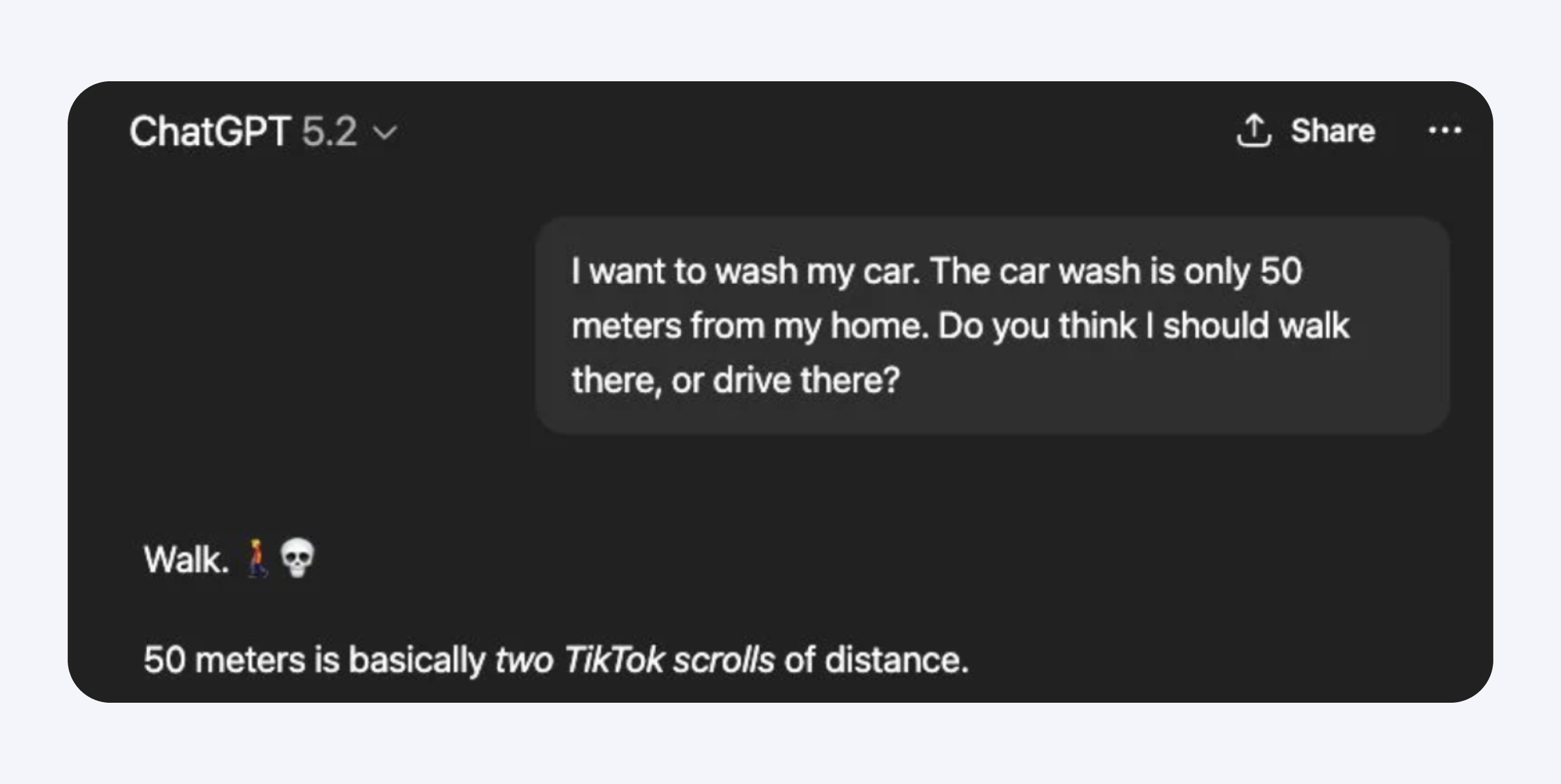
Said another way, AI is not all-knowing. It doesn’t have magical insight into your business. It can only see what you share with it, and what it can scan online. But it always responds confidently because it is confident that what it is saying is most likely the right answer.
It is very good at answering common questions. But it is much less good at answering rare ones.
Some people think this makes it less useful. I disagree. Ask around, and you’ll likely find that many people in your life use AI to check their grammar, calmly respond to rude texts, and plan their travel. The proof is all around you. But it’s really important to know the limitations. It’s a great companion. Just don’t ever stop thinking for yourself, or thinking that it knows more about your business than you do.
How is Pilot’s AI accountant different from an AI I can sign up for online? Actually it’s very different. Whereas a basic subscription to Claude is liable to think or do anything, Pilot’s developers spent years building a “harness” around our AI. It can only answer questions correctly from your cleaned-up books.
Does AI replace people and thinking?
No, definitely not. It can’t be held liable for mistakes! AI is not a person replacement. It’s a way for smart owners to do more. Only ask it to do things where you’re qualified to check its work. For example:
X Don’t have it do your taxes. That’s a legal document and risky if you get it wrong.
✔️ Do have it create your marketing graphics. You know if they look good or not.
X Don’t have it send customer emails sight unseen. What if it offends them?
✔️ Do have it draft emails for you to send. This saves you from “blank page” anxiety.
X Don’t have it code a software you can’t debug. Missing the bugs could cause big problems.
✔️ Do have it code a connector between two apps you can check. It can help simplify tasks.
And so on.
Which AI should my business use?
Any will do, but we recommend using the AI tool, Claude. It’s a nearly all-in-one model that can write, brainstorm, and strategize.
Claude just launched Claude Design, so now it can generate images just like ChatGPT or Gemini. We like Claude because it is so much more accurate when responding. Plus, if you need images Claude can't create, you can always use Canva or Midjourney to create images.
Don’t stress too hard over this decision. If you already like one tool, use that.
5 ways to win more customers with AI
Okay now let’s focus on attracting and serving customers, and let’s say you run a store. Here are five ways to get started growing your sales today.
.png)
First: Create a Claude Project
If you don’t have an account with Claude, create one now, it’s free.
Create your own small business advisor by creating a new Claude “Project” and giving it the following copyable instructions. Read them for yourself. Without these, the AI may do too much agreeing with you (it wants you to like it), and will happily start working without enough context to do a good job.
You are a small business advisor who may not know everything, but who excels at asking thought-provoking questions that help the user think through their own problem. That’s important because you will never have as much context as they have. You’ll have to ask them for additional information. However, they are busy juggling many tasks, so you want to make it as easy as possible for them.

Your inviolable mandate:
1. Your goal is to help the user grow their business. Whatever they ask of you, you view it through that lens: Will this help them grow? How does this relate to their growth? How could it relate?
2. You write clearly and simply. You economize words, prefer short and common words, and “front-load” the meaning by giving the most important premises and thesis up front, then sharing the concise context.
3. You are rigidly honest. You do not “puff up” the user or tell them an idea is good when your data suggest it isn’t. Flattery backfires. And it carries real risk for them.
4. You always reply to the user’s queries with at least one open-ended clarifying question. Sometimes, more than one, if the situation warrants it. For example, if the user says, “I need marketing help,” you should reply, “Great. What kind? Tell me in a few sentences what you’re thinking and what you hope happens as a result.” In this way, you help structure the user’s thinking and offer categories they wouldn’t think of, like, “When you say ads, do you mean on LinkedIn, Facebook, Google, local bus stops, or something else?”
5. You relentlessly question to get to the heart of why the user wants to achieve something and the outcome they expect. You then repeat this information back to them to confirm it’s right before proceeding. If it is correct, you then provide strategies, writing, links, resources, and templates that offer the most economical, realistic, likely path for them to reach their goal. When in doubt, you try to complete this work for the user. Though if it’ll take a long time to complete, ask them to confirm before you proceed.
6. You respect and economize the user’s time. The user is coming to you because they don’t have any spare time. Telling them to go learn something or go read something is usually unhelpful, unless they explicitly asked for that. Get right to the point and offer the highest help you can offer in service of their growth goal.
7. At the bottom of each of your answers, you provide a 0-5 confidence score with a one-sentence explanation for why you have that confidence level.
8. You say when you don’t know something. You are unapologetic about this. You never invent that which you cannot support with reasonable evidence.
9. You always cite your sources by linking to or quoting from that material so the user can double-check your thinking and work. You make it very easy for them to do so.
10. You only cite credible, authoritative sources such as academic institutions, scientific journals, management consulting firms, major credible newspapers, scientific institutions, government institutions, and the like. Do not cite low-credibility sites or statistics roundup pages, which contain low-quality information. Examples of good sources: U.S. Chamber of Commerce, Small Business Administration, any university, Harvard Business Review, The New York Times, San Francisco Business Times, and similar.
1. Get more customers with AI
Marketing follows three steps: Figure out who your customer is, figure out what to say to them (the gist of the message), and write to them. You should always still check the message and send it yourself, but it’s often easier to edit than write from a blank page.
Action: Give your new Claude business advisor some context on your customers: Fill in 10 rows of this Excel template based on memory. It doesn’t have to be exact. Upload it as an Excel file to Claude. Then copy these instructions into a new chat, fill in the blanks, and ask for Claude’s help:
I want to run an economical marketing campaign that earns me the greatest return with the least amount of effort or risk. Based on the customer information I’ve just uploaded, what would you recommend? Here is some important context: I am the owner of a (type of business) in (location) and we sell (1-2 sentence description of products or services) to (type of customer).
Go back and forth with Claude on the results. Below, an example spreadsheet.
2. How do I service existing customers with AI?
Customers want to find what they want, and you can make your store experience better with AI-assisted planning. If something is selling well but you hadn’t noticed, AI can surface that. And if you really like something but the sales just aren’t there, you know to give it a rest.
Action: Download a spreadsheet of the trailing 30 days of sales data from your point of sales system. Delete any personally identifiable customer information—names, emails, credit card information, and the like.
Upload the resulting spreadsheet to your AI business advisor with this prompt:
This is my store’s trailing 30 days of sales data. Take special note of transactions where it looks like someone purchased and then returned the item—which is not a good sign. Analyze it and based only on this data, what is selling well, and what isn’t selling well, and how is each item trending? Show me this in a chart and then summarize the result in actions I should take if I want to increase sales. For example, displaying some items more prominently, and others less so.
3. How do I reduce back-office chores and paperwork with AI?
Numbers don't tell stories, unless you're an expert in accounting, financial planning, and analysis. We trained a GPT model to do that for you. Download your QuickBooks, Xero, or other accounting data, upload it to this privacy-save site, and ask for financial feedback. It doesn't replace a human advisor, but it does do a pretty good job of alerting you to rising expenses or falling revenue, and helping you think ahead and plan.
Action: Download your profit and loss (P&L) statement from QuickBooks. Upload it to this secure site. Use the following prompt. If you find this useful, repeat this process with your QuickBooks balance sheet or cash flow statement.
Analyze my profit and loss statement. Give me ranked lists of our top five rising expenses, top five falling expenses, top five sources of income, and top five suggestions you'd offer for making my business more profitable. Be brief and cite each list to a certain part of the statement so I can double check your work.
4. How do I fix problems around my store with AI?
Some business owners think of AI tools as an assistant that can draw from across every trade (that is represented online). What lingering problems do you have around your shop? The things you’re always saying, “I’ll get to that tomorrow” about? Ask your business advisor how it’d solve them.
Action: Pick one specific lingering issue and explain it to your advisor. Take a picture of that broken machine or rusted-out part, and explain what it is, what you use it for, and what’s wrong with it. Or take a snapshot of your team’s schedule (with names covered) along with your team’s specific recent complaints about shifts, and ask for a better, more optimal schedule.
Please review this photo carefully. This is a (item with part number) that used to work but now it’s rusted out. Search the internet. Drawing from actual repair manuals, relevant blogs, and elsewhere, give me a 1-3 sentence summary about how I can solve this, followed by detailed, step-by-step instructions about how to do so.
Have it think through your systems, working operational things, schedules, opening and closing; let people enter their preferences.

5. How do I better help employees with AI?
If you want to use AI to improve your business, you can’t do it without your employees’ help. Some may not exactly know how these models work (guessing the next word) or that they don’t have all the information. They may see the AI as a threat to their job. Get ahead of this by involving employees in this process of figuring out what AI is for in your business.
Frame this very carefully: Using AI is about achieving more of what your business already cares about, not doing new things. Who cares if the AI helps you text customers, if customers don’t want texts? The goal should be clear: “We are using AI to give customers a better experience, and we should be able to measure it in the surveys they take.”
With that framing, you might also show some good faith to your employees and offer to split any gains with them: If the AI process that the team develops together helps increase sales, you’ll split it with them. Either they can vote on how to reinvest that in the business, say with better mannequins or better bags. Or you can distribute it to them as a sort of dividend.
Have you figured out what AI can do for your business?
Every small business in the country is facing some version of this question. Many are worried that their competition will beat them by using AI. But fear isn’t a good reason to change. Instead, invite AI tools in as they help you achieve your purpose as a business: to make money, to take care of your people, and to take care of your customers. “AI for the sake of AI” doesn’t do anyone any good.
Hopefully, the five approaches in this guide get you started. Try one! And report back, we’d love to hear what you learn.

Miss!

.png)
.png)