
Cash flow management for startups


Cash drives the survival and growth of a business, and poor liquidity is a common cause of failure. Too many founders struggle to track, forecast, and optimize their cash.
This guide outlines three critical tips that turn cash flow management for startups into concrete steps you can start adopting today.
- Building a simple forecast
- Tightening collections and spending
- Developing clear metrics to inform decisions
Much of what we discuss today will draw from Pilot’s bookkeeping, accounting, and advisory frameworks. If, after reading this, you would like to learn more or partner with Pilot, please contact our sales staff.
Why cash flow management matters for startups
Cash flow is all about timing, control, and visibility. Wrangle those, and you’ll mitigate a lot of your startup money problems.
Common cash flow challenges
Many startups have amazing revenue potential, but this can be compromised when timing and control are not in your favor. Invoices go out, but you don’t see the cash in the bank until weeks later. Payroll, rent, and operational tools continue to get paid regardless of your sales that month. Seasonal, cyclical, or market dips can widen the gap, and without a clear cash flow forecast, the best you can do is guess.
Managing cash flow means controlling how money comes in and goes out, thereby eliminating surprises and variables along the way.
Impact on startup success
A lack of awareness of cash flow poses significant risks. Payroll gets missed, vendors aren’t paid, product work stalls, and leadership spends valuable time firefighting instead of building.
Investors view poor cash management as a discipline problem, affecting terms and timing for the next round of fundraising. Strong cash management for startups turns a critical metric that investors look for into a highlight of your business, not an obstacle. It also lends credibility to your forecast.
Core components of cash flow management
Effective cash flow management for startups rests on five pillars:
- Forecasting
- Expense control
- Receivables and payables
- Metrics
- Scenario planning
Let’s break each one down.
Cash flow forecasting
Forecasting is the lifeblood of cash flow management for startups. Starting with something simple, such as a 13-week view, is a good first step for near-term control. However, a monthly view for the 12 months is the standard for examining a long-term forecast.
It’s important that you base your assumptions on real patterns like sales cycle length, invoicing cadence, payment terms, churn, renewal timing, and expected collections. That might sound like a lot, but remember that it doesn’t have to be a perfect model. The goal is to gain a clear view of cash so you can address problems before they become disasters.
Expense planning & cost control
Cash management for startups thrives when spending is deliberate. Clearly define your fixed and variable costs and stress-test each line against outcomes. Make tough decisions about must-haves vs. nice-to-haves and set a small contingency buffer aside for a rainy day.
Most importantly, align major expense items, such as payroll, marketing, and operational tools, with milestones and leading indicators. If you’re having a good month, scale your business wisely. If you’re having a bad month, make microadjustments that help you get through it, rather than irreversibly impacting the upcoming quarter or year.
Receivables & payables optimization
To the extent possible, shorten the bridge from invoice to cash. State clear payment terms, request upfront deposits when possible, provide multiple payment options, and follow up on delayed payments.
Be willing to negotiate supplier and vendor terms to find providers that align with your budget and interests. Control mechanisms, such as batching invoices and scheduling vendor payments in the future, help you preserve liquidity without harming valuable relationships.
Remember, you’re pursuing reliable, consistent cash conversion and visibility.
Key metrics to track
For more information on key metrics investors look for, click HERE.
Investors don’t want glamor stats. They are looking for metrics that demonstrate the productivity, potential, and discipline of your company, such as:
- Burn rate
- Cash runway
- Operating cash flow
- Net cash position
Liquidity ratios help, but founders and investors align the quickest around burn rate and runway. Commit to reviewing these regularly and make decisions that help show these metrics in a positive light.
Scenario analysis
How to manage cash flow includes planning for the best and worst outcomes. Maintaining a base position is a great start, but preparing for upside and downside shows another level of sophistication. Hypothetically tweak your bookings, churn, hiring, and LTV to see what the best and worst case scenarios for those metrics do to your financials.
Under each scenario (best, worst, base), show how you would react under those circumstances. From hiring to discretionary spending, demonstrating that you’re already considering how unexpected variables can be addressed is valuable to investors.
Example: Startup cash flow statement
Let’s build a concrete example, practically showing how a startup can manage cash flow, and discuss fundraising needs with investors.
Company profile and qualifiers:
- B2B SaaS startup at ~1.0M APR (Annual Percentage Rate), targeting 100% YoY growth
- $1.2M in starting cash
- Collections: Net-30, 80% paid in the month, 20% in the following month
- Churn: ~2% monthly churn, stable renewals
- Gross margin: ~80%
- Operating cash: Payroll-heavy, step-ups each quarter with hiring ramps
Statement summary (Quarterly view)
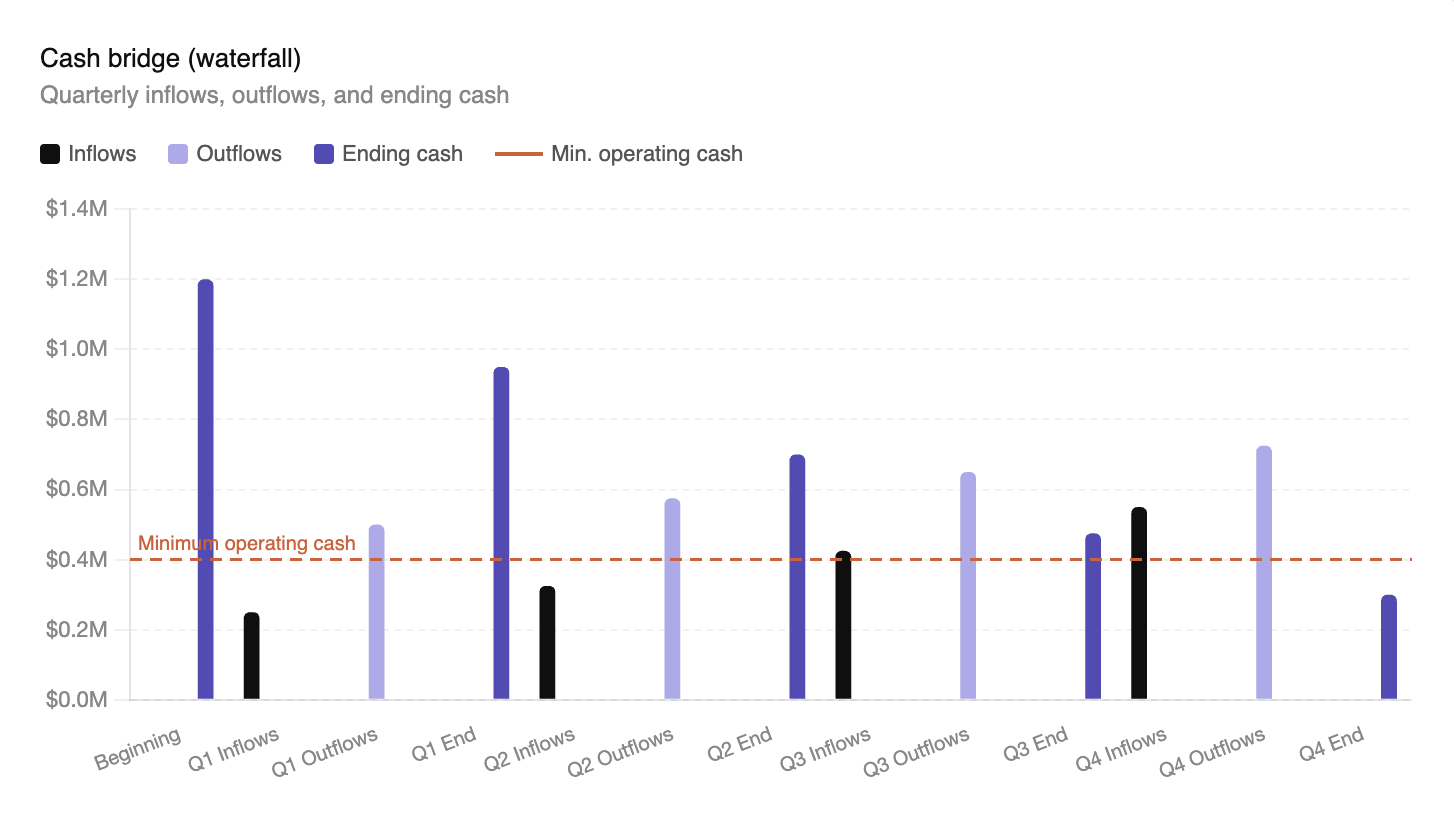
In the example below, burn narrows as growth improves, but cash runway remains the constraint. This type of table can be used to identify funding gaps or implement cost controls to stay above the minimum operating cash threshold.
Cash flow impact visualization
Visuals can also help paint the picture, such as a cash bridge (also known as a cash waterfall) and a cash balance timeline. These tools can help you align with investors on when funding is needed and how much is required. These types of graphics pair well with scenario planning to visually show the variables that can accelerate or delay these projections.

Best practices for managing startup cash flow
Clear systems > One-off fixes.
Better habits keep cash flow for startups predictable and defensible.
Transparency and documentation
Maintain clean, accessible records of cash flow movement. Have one system that manages invoices, bills, and approvals. From there, create easy-to-understand dashboards that show inflow, outflow, burn rate, and runway. You’ll be busy running your business, so the easier these metrics are to see at a glance, the less time you’ll spend having to reverse engineer them every time you want to check in on your cash.
Benchmarking and validation
Set up comparison KPIs (key performance indicators) to measure your metrics against burn, gross margin, and net retention. Historical data can help you validate future assumptions. If collections are slipping or churn is rising, ensure it’s reflected in real-time.
Iteration and updates
Lastly, set regular times to review and update your forecast. At a minimum, it should be quarterly. Hiring changes, pricing fluctuations, vendor terms, and payment timing will all impact the reality of your finances, and these changes must be reflected in the books as closely as possible in real-time. Regular review enables you to adjust your assumptions in response to changing market conditions and growth trends.
How Pilot supports cash flow management
Pilot helps startups track, forecast, and optimize cash flow with bookkeeping, accounting, and CFO advisory for early-stage and growth companies. Backed by real, experienced CFOs, we standardize your chart of accounts, reconcile on schedule, and build a unique cash flow model you can approve and maintain. You’ll love the clear dashboards for burn, inflow, outflow, and runway, as well as the guidance on how to manage cash flow through changing market conditions.
If you enjoyed this, you’ll likely appreciate the other playbooks we've built for startup founders.
If you’re ready to collaborate with a team of experts, schedule a consultation.
Frequently asked questions
What is cash flow management for startups?
It is the system for tracking, forecasting, and optimizing cash inflows and outflows to maintain liquidity, extend runway, and support growth.
What metrics matter most for cash flow for startups?
Focus on burn rate, cash runway, operating cash flow, and net cash position. Liquidity ratios add context, but burn and runway drive decisions.
How often should startups update forecasts when managing their cash flow?
Review monthly for most teams and at least quarterly. Update sooner if sales cycles, payment terms, hiring, or churn assumptions change.
How to manage cash flow during a downturn or slow sales cycle?
Tighten collections, negotiate vendor terms, defer nonessential spend, and revisit hiring plans. Refresh the forecast and scenario plan to ensure the runway remains protected.
How does cash management for startups differ from GAAP reporting?
GAAP focuses on revenue recognition and accrual timing. Cash management tracks actual money in and out, which is what funds payroll, vendors, and growth.
What tools help with cash management for startups?
Use a 13-week cash model, an AR/AP dashboard, and payment rails that reduce friction for customers. Pilot integrates these into a single workflow with expert support.

Miss!


.png)
