
A small business tax guide for beginners [2026]

.jpg)
The U.S. has a really complex tax system. Below is an illustration the IRS created to clarify the federal tax structure. To them, this is the simple version. If it seems complicated to you as a business owner, you are not alone.
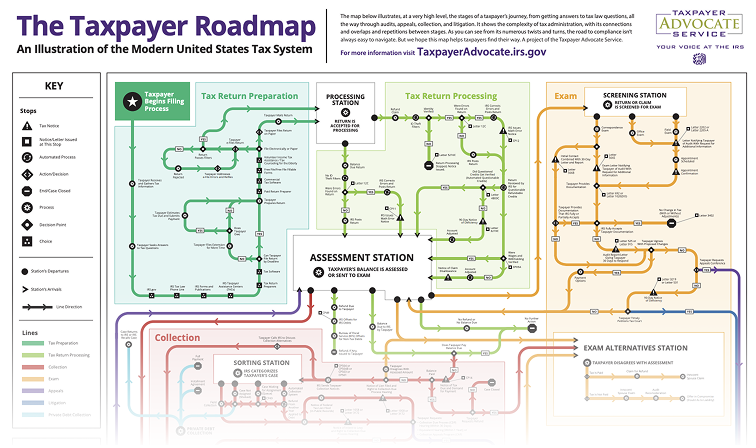
In this guide, our tax team explains in simple terms what taxes and filings your business should pay attention to—without all the tax jargon. Our goal is to demystify small business taxes enough for you to feel confident in running your business.
This isn’t tax advice—but the team here can offer that.
.jpg)
One piece of advice? Find a bookkeeper
If there’s anything worse than figuring out what taxes your business owes, it’s trying to figure that out while poring through shoeboxes of receipts. Don’t do that to yourself. Get a bookkeeper to do your books every month. They’ll “certify” each month’s books and then they’re locked. That way, at tax time, you have a complete record of 12 months ready, and you don’t have to pay a tax accountant to go through it all.
Compared to your and that accountant’s time, a bookkeeper is cheap. Do yourself a favor and find one.
Here’s a guide on how that also helps you save at tax time.
.jpg)
To know where you may owe taxes, figure out your entity type and where you operate
First figure out what company entity type your business is. There are companies (C-Corps) and there are limited liability companies or partnerships (LLCs or LLPs).
Somewhat complicating this, an entity type can file taxes as if it’s another entity type, if it chooses. For example, a corporation (C-corp) can file as a corporation. But it can also elect to file as something called a small business corporation (S-corp), which in some cases, means you pay less taxes. (It really depends—pay an expert to run a study.)
And limited liability partnerships (LLPs) usually file as partnerships. But they can elect to be taxed as a C-corp or S-Corp. A limited liability company (LLC) that only has one owner typically files as an LLC, where the owner pays most of the taxes on their personal tax return (known as a “pass through entity,” because you’re being treated as an individual for tax purposes). But LLCs can also file as C-Corp or S-Corp if they like.
How are you set up to be taxed? That’s your chosen entity type. This is something you tell the IRS, and it’ll be on your prior year’s tax return. If you aren’t sure, look at your formation documents or ask the person who formed the company for you.
Next figure out your jurisdiction, which is a list of all the states where you do business. If you’re small and local, this is easy—it’s probably just your primary location. For larger companies with many physical locations, remote employees, or significant sales in multiple states, it can get complicated. For the purposes of this guide, you can assume that “jurisdiction” means any state and city where you have any of the following:
- Significant sales—$100k+ dollars per year
- Full-time W-2 employees
- Partners in the business
- A physical location—property, office, warehouse, etc.
.jpg)
C Corp vs. S Corp vs. LLC / LLP: The federal tax basics
The main differences between these entity types come down to who pays the income tax, and how owners are taxed for payroll and self-employment. Income taxes happen at the entity level and/or owner level, self-employment taxes happen at the owner level, and payroll taxes happen at the entity level.
This is fairly nuanced, but generally:
C Corporations are taxed:
At the entity level
- The business pays federal income tax at a flat 21% rate.
At the owner level
- Owners are taxed on W-2 income and dividend income.
Payroll taxes
- Payroll taxes apply to wages paid to owners and employees.
- Dividends are not subject to payroll or self-employment tax.
.jpg)
LLCs and LLPs are taxed:
Not at the entity level (though you must still file)
- The business itself does not pay federal income tax.
- The business files a partnership return to report income or loss and how it’s split among owners. They issue a K-1 to its owners to report the split.
- If the LLC only has 1 owner, then it does not need to file a business return and K-1. The profit or loss of the business is reported directly on the owner’s personal tax return.
But rather, at the owner level
- The profit or loss is “passed through” to the owners and are reported on their personal tax returns.
- This owner pays self-employment tax (15.3% for Social Security and Medicare).
Payroll taxes
- Payroll taxes apply to wages paid to non-owner employees.
- Owners themselves cannot be on payroll unless the LLC elects C or S-Corp status (see below).
S Corporations are taxed:
Not at the entity level (though you must still file)
- The business itself does not pay federal income tax.
- The business files an S-Corp return to report income or loss and how it’s split among owners.
But rather, at the owner level
- Owners who work in the business must be paid a reasonable salary, which is subject to payroll taxes.
- Any profits pass through to owners and are not subject to payroll or self-employment tax.
Payroll taxes
- Payroll taxes apply to wages paid to owners and employees.
- Pass-through profit is not subject to payroll or self-employment taxes (this tax savings is one of the upsides to an S corp election).
.jpg)
Depending on the nature of your business, you may also pay federal excise taxes
“Excise” is just the IRS’s term for “other” taxes. For example, import duties and tariffs, or taxes on plane tickets, alcohol, cannabis, fuel, hazardous materials, and the like.
Excise taxes are taxes on:
- Import tariffs
- Alcohol
- Cannabis
- Gambling
- Road use
- Gasoline
- Hazardous materials
- Transportation (cruise ships)
To understand in detail, you'll have to read the IRS's publication 510. Or, ideally, use a tax preparer who knows.
What must I pay in state taxes?
You also have to pay taxes in states where you do a meaningful amount of business, have employees, have offices, and so on. That means you are probably also liable to pay:
State franchise tax: A fee for doing business in that state. Not all states charge this, but for the ones that do, it’s typically under $1,000 for small businesses.
State income tax: Corporations pay a tax on the percentage of their income they earn in each state. LLCs, LLPs, and S Corps pass through the state income or loss to their owners, just like federal taxes.
.jpg)
Gross receipts tax: This is a tax on gross receipts earned by business, paid by the business, and applies to all entity types in state that impose this tax (only a handful do).
Sales taxes: 45 of the 50 states impose a sales tax on most goods and certain services. While the buyer actually pays the sales tax, it’s the business’s responsibility to compute the right amount, collect it, and remit this to the state or city.
Property taxes: This is a tax on property you own or lease, imposed by some localities. This is typically handled through the states’ localities.
Payroll taxes: States and localities have their own withholding and unemployment insurance taxes that the business / employer is responsible for.
What must I pay in local taxes?
As if federal and state were not enough, your county and even city might charge additional taxes. This is difficult to write a guide for, as each locality is different. The city of San Francisco charges a “health fee” on top of food and restaurant sales. Chicago charges, funnily, an “amusement tax” on event, digital, and physical entertainment goods and services.
- Local sales tax
- Commercial rent taxes
- Property taxes
- Local income taxes
- Local payroll taxes
- Gross receipts taxes
5 things that will complicate your taxes
What we’ve covered in this guide is a simplified version of your tax reality. A tax accountant will have more questions for you, about situations that could complicate your tax situation. For example, if any of the following apply, you should definitely seek help from an expert.
Hiring remote employees in many states
Because states provide unemployment insurance, training, and other services to workers, they want to know about every employee you hire. And because many companies have tried to skirt these taxes by classifying employees as 1099 contractors, many states have created “tests” that companies must pass to avoid paying these taxes.
In California, it’s called the ABC test:
- Does the worker govern their own time?
- Does the worker perform work outside the usual course of the hirer’s business?
- Is the worker part of an independently established trade or occupation?
You own multiple businesses
Multiple businesses and streams of income mean you need multiple sets of financial books. That way, you know which income and expenses are attributed to each.
Your income varies a lot quarter-to-quarter
Your business must pay quarterly estimated taxes if it’s profitable. If your business changes a lot quarter to quarter, it can become complicated to calculate how much you owe for the year.
You file jointly with a spouse
Joint filing can get complicated. If you have an LLC and count everything as personal income, but you also have separate income from your spouse, how do you calculate your quarterly estimated taxes? Further, how do you calculate that if both of you run businesses?
Selling software
While you typically pay taxes based on where the product is shipped or used, it can be more nuanced for software. Certain states apply specialized sourcing rules that consider where the product is used, where that customer’s users are located, or where the benefit of the service is received.
Selling products in all 50 states plus territories
Opening an ecommerce store is easy until you realize that every jurisdiction you sell into wants a cut. Lots of companies use a service like Numeral or Kintsugi to handle sales taxes.
How can you reduce your small business tax exposure?
The best way to make taxes easy on yourself is to keep careful records. Be sure to count all your business expenses,especially ones you or others might have put on a personal card. Apply any past year losses to this year to reduce your total tax burden, and if you’re filing on a cash basis, near the end of the year, if you can pay next year’s expenses a few weeks earlier in December, do so.
But at the end of it all, nothing will help more than having monthly bookkeeping so everything’s always up-to-date, and a tax accountant who can help you file and keep you compliant.


Miss!


.jpg)