

Built for how new franchisees actually get started
The easiest time to get your tax setup right is before your first location opens, and Pilot works with franchisees at every stage, from a franchise agreement you just signed to a network you’ve run for years. If you’re a few months from opening or just past your first year, the first-year deductions section below is exactly the kind of thing worth getting right from the start rather than fixing at tax time.
.svg)
Franchise fee amortization, done correctly from day one
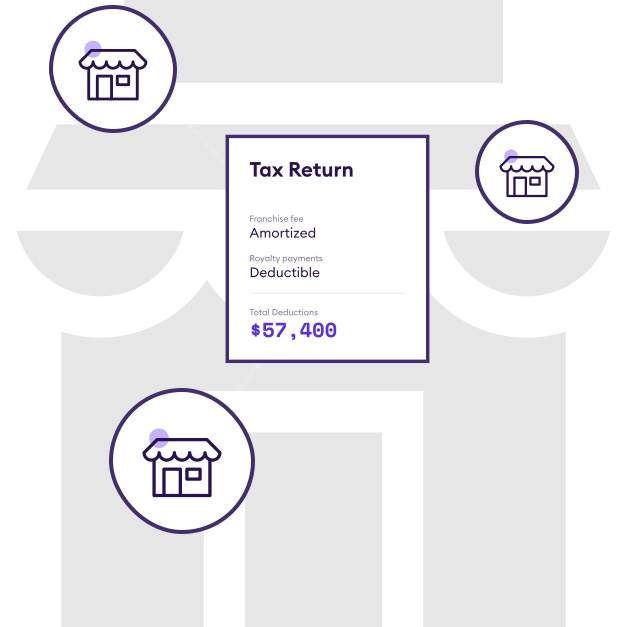
Your initial franchise fee is treated as a Section 197 intangible asset, which means it’s amortized over 15 years (180 months) using the straight-line method, regardless of how long your franchise agreement actually runs. A $50,000 franchise fee produces roughly $3,333 in deductions per full year, not a lump-sum write-off in year one. Pilot sets up this schedule correctly when you open, so it’s not something your tax preparer has to reconstruct at year-end.

Royalty payments and ad fund contributions, deducted the year you pay them
Unlike your franchise fee, ongoing royalty payments and advertising fund contributions are ordinary business expenses, fully deductible in the year they’re paid, with no amortization required. Most franchise agreements charge royalties as a percentage of gross sales, commonly in the 4% to 8% range. Pilot categorizes these correctly and separately from your franchise fee, so they’re never miscapitalized.
.svg)
Multi-state and multi-entity filing, handled as one process
Own locations in more than one state, or structured each one as a separate entity? Pilot prepares federal and state filings across your entire network together, rather than coordinating a different CPA per location or per state.
.png)
"Franchise tax" and tax on your franchise business aren’t the same thing
"Franchise tax" is a state-level fee charged for the right to operate as a corporation or LLC in that state, like Delaware Franchise Tax, and it’s owed whether or not your business is profitable. That’s separate from the federal and state income tax your franchise business owes on its actual earnings. Pilot handles both: your entity-level franchise tax filings and your income tax preparation, together.
.svg)
What’s deductible in your first year
Pre-opening costs like franchisor training, discovery day travel, and grand opening expenses generally fall under Section 195 startup cost rules: up to $5,000 can be deducted immediately, with the remainder amortized over 180 months. That’s a separate rule from your initial franchise fee’s Section 197 amortization, and mixing the two up is a common first-year mistake. Pilot classifies each cost correctly from your first month.

Choosing the right business structure
Whether an LLC, S-corp, or another structure minimizes your tax burden depends on your income, number of locations, and state, not a one-size-fits-all answer. Pilot’s tax team can walk through the tradeoffs for your specific situation as part of your engagement.
Built for your franchise category
Pilot works with franchise owners across home services, print and signage, consumer services, and fitness, and adapts to what each category’s tax picture actually looks like: job-costing and equipment deductions for home services, or membership revenue timing for fitness.


Tony Jolly
CEO and Founder, Crenshaw Coffee
Pricing
Federal & State filing
Delaware Franchise Tax filing
Quarterly Estimates
Schedule C
Federal & State filing
Delaware Franchise Tax filing
Up to 10 1099-NEC filings
Federal & State filing
Delaware Franchise Tax filing
Up to 10 1099-NEC filings
Purchased alongside Pilot Bookkeeping
Purchased alongside Pilot Bookkeeping
Purchased alongside Pilot Bookkeeping
Frequently asked questions

Mostly none exclusively—the same tax code applies to every business. What’s different is which categories of expense you’ll see: franchise fee amortization, royalty payments, and ad fund contributions, each with its own correct treatment.
If your current preparer isn’t handling franchise fee amortization or multi-entity filings correctly, switching mid-year is straightforward: Pilot picks up your existing records and current-year filings without restarting your books.
Look specifically for a provider that can describe how Section 197 amortization and ordinary royalty deductions work for franchises, not just general small-business tax prep. Pilot’s tax preparers work with franchise owners specifically.
Pilot’s tax preparers handle the filing, amortization schedules, and entity-level tax work directly from your bookkeeping records. You’re responsible for answering questions about your business when asked and reviewing filings before they’re submitted, not assembling the numbers yourself.
A CFO works best when Bookkeeping, Operations, and Tax are handled
.svg)
Bookkeeping
Accurate, on-time books your CFO works from. Software handles the volume, and our team finalizes every close. The foundation every Pilot CFO engagement starts with.
.svg)
Outsourced Operations
Payroll, AP/AR, vendor management, and expense operations. For founders who need finance and operations support from the same partner, on one bill.

Tax
R&D credits, federal and state filings, and the tax work that can fall through the cracks at a fast-moving company. Works with your CFO during year-end planning.

Amortization schedules, royalty deductions, and multi-state filings, done right from your first year. Opening a new location or heading into tax season are both good moments to get this set up before it becomes a scramble.