
Want to save on taxes? Get a bookkeeper

.jpg)
To file your business’ taxes, your accountant needs to know every single transaction that occurred in your business. Every expense, every payment.
That can mean thousands of transactions, and introduces a real challenge: Will you even remember them all at the end of the year? Hunting through credit card statements will eat up your time. It’ll eat up your accountant’s time, and they aren’t cheap. That’s why it’s so smart to have a more reasonably priced bookkeeper close your books each month. That way, at tax time, you’re ready.
That’s reason number one, and a big one. But there are actually seven other reasons why a bookkeeper can save you money at tax time.

1. It helps you avoid future expenses
When you categorize your books monthly, you spot unnecessary expenses—and can cancel them. For example, that extra office phone line, the software that one employee signed up for before they quit, that business insurance policy you don’t need anymore. Whereas if you wait until tax time, you’ve already paid all that out and probably can’t get a refund.
2. It helps you grow your margins
For founders and business owners, there are two types of math: head math and book math. Without knowing the book math, you always end up way overspending.
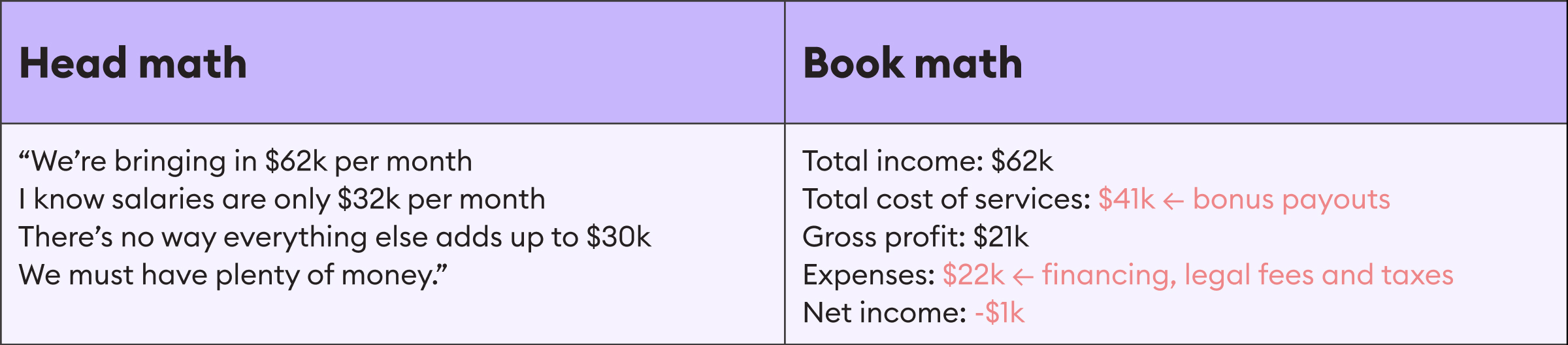
In practice, you want your financial data in a software where you can “double click” on each expense to investigate. Why did your cost of goods sold go up? If wages rose, whose wages? And in expenses, what happened and how can we avoid that in the future?
3. It reveals tax deductions and efficiencies
Sometimes your tax accountant can advise on how to make your company more tax efficient. For example, if you’re thinking of raising serious money, investors probably want you to re-incorporate in Delaware. That’ll change your taxes. And if you’re a professional services LLC with high wages, you’ll want that tax accountant to run an “S-Corp” analysis to see if you’d save more money by paying yourself a W-2 wage. Plus, you can know which things you can expense and which you can’t—and guide your purchases accordingly.
In all cases, you have to make that change as early in the year as possible. If you wait until tax time next year, you’re stuck. You can’t retroactively change your entity type or location.
Ask your tax accountant to analyze these scenarios:
- Income rising? Run an S-Corp analysis on your LLC, file to switch before December.
- Paying for healthcare with your personal card? Switch it to the business.
- Delaying that continuing-ed program because of cost? Do it now and write it off.
When you have monthly insights, you can make smarter tax decisions.
4. Monthly bookkeeping helps you reduce errors
A tax team that has to review hundreds of your transactions all at once, in one sitting, is likely to commit errors. Whereas if you use a monthly bookkeeping service via a software that leverages AI, you catch all those mistakes as you go. The AI categorizes the transactions quickly, and a human checks the work, trains the model, and certifies the books.
By the end of the year, you have error-free books, which means your taxes take less time to prepare.
5. It saves you from quarterly overpayments
Businesses have to pay estimated taxes quarterly. If you estimate incorrectly, you can end up losing money. If you underestimate, you may have to pay fines. But overestimating is sometimes worse—you’ll pay estimated taxes on money you don’t owe, and the government gets to hold onto it until after you file taxes the next year.
Whereas if you have an expert bookkeeper closing your books month after month, they can give your tax accountant a much better sense of your estimates. Precision really matters here. Let’s say the law firm you’re using is named Laslo & Vegas, and should get counted as a business expense. But if nobody’s checking the books and noticing that it’s getting counted as Las Vegas, you’re paying taxes on that retainer since that’s a non-deductible entertainment expense.
6. It helps you fit your chart of accounts to the business
Bookkeeping sounds like a science but it’s really part art. Because while the Generally Accepted Accounting Principles (GAAP) tell accountants and bookkeepers roughly how to code transactions, there’s a lot it leaves up to choice. Once you start using a set of codes, it’s expensive to change.
Whereas you are progressively having an expert bookkeeper refine and tweak your codes based on how your business is growing and spending, you end the year with a chart of accounts that perfectly fits your business.
Plus, if you don’t get those accounts right, or they turn into a mess, it can’t help you answer questions about your business. Here’s an example from the agency world:
Let’s say you want to know how much you’re spending on full-time versus part-time employees. And whether those employees are writers, marketers, or designers. If you wait until the end of the year, someone has to go through all those individuals’ names and hundreds of invoices to figure out who did what. And for that entire year, you don’t have that insight—and potentially run some months at a loss.
But if you had a bookkeeper set those account codes as you go? They’d set automation rules that’d correctly categorize all those people and give you a neat, tax accountant-friendly breakdown.
7. It saves you from year-end rushes and “catch-up” accounting fees
The worst-case scenario is you do no bookkeeping, then ask your tax accountant for help in March or April. By that time, it’s probably too late. Tax season is a nightmarish time for accountants and they’ll probably be booked. Which means you’ll have to search for other accountants, and probably the accountants you wind up with have availability for a reason. Or they’ll charge you extra for having to do “catch-up” accounting.
Don’t leave things to chance—ensure you get to work with your preferred tax accountant, and give them ready-coded books well in advance.
Monthly bookkeeping saves you money at tax time
Not only is monthly bookkeeping cheaper cost-wise than catch-up bookkeeping at tax time, it helps you run your business and save in ways far beyond claiming deductions.

Miss!

.jpg)