Recognize the big sale appropriately—Hapily sold one of its lines of business to a co-founder. Pilot helped them recognize that revenue to minimize the tax liability.
Prepare their taxes—With a mind to maximizing deductions and protecting their profit.
Accurate bookkeeping—Hapily wanted a bookkeeping team that knew venture-funded startups.
Quick financial answers—“Pilot makes it easy to get the information I need. Being able to have all that context is really powerful."
.png)
Pilot solved something that probably would've been a big, expensive, complicated problem for us down the road. That experience was amazing.
.png)
Connor Jeffers and his co-founders built a professional services firm, Aptitude 8, around helping companies implement the marketing software HubSpot. The business succeeded so quickly, the founders thought, why not try another revenue stream? When HubSpot launched an app store, Connor and team built a few apps. Those took off.
Soon they were confronted with their own success, had to prioritize, and decided to split the businesses—one services, one software. Their existing accounting firm wanted $20,000 to do the the books for Hapily, the new business, even though it was venture-funded and the initial work was minimal. Connor and team had heard about Pilot on the Acquired podcast and gave it a try.
Their Pilot bookkeeper surprised them by not doing as asked, and instead brought in help to advise on how to best structure the sale. This ended up saving Hapily a lot of money.
“It’s so easy to do what the client says, but we were wrong,” says Connor. “Pilot didn’t just say ‘Yes.’ They intervened and, at no extra cost to us, involved someone to get us sorted out. I’ve been doing this a long time and I have not had many experiences this positive.”
Agencies have lots of advantages. They’re easy to start and tend to be profitable from day one. But they don’t scale the same way a software does, with low or zero marginal costs. Connor and team grew their agency to 75 people and eight figures in revenue and decided it was time to experiment with other models.
Around this time, HubSpot launched an app store and Connor and team built a few apps, one for events management, one for pricing and quoting. The idea was to diversify their revenue. They’d create one app that was free, to attract attention, and another that was to make money. This worked remarkably well. So well that they made the decision to spin out the software business on its own, which became Hapily. During that transition, one of the co-founders raised money and offered to buy the price-quoting part of the business—which sounded great.
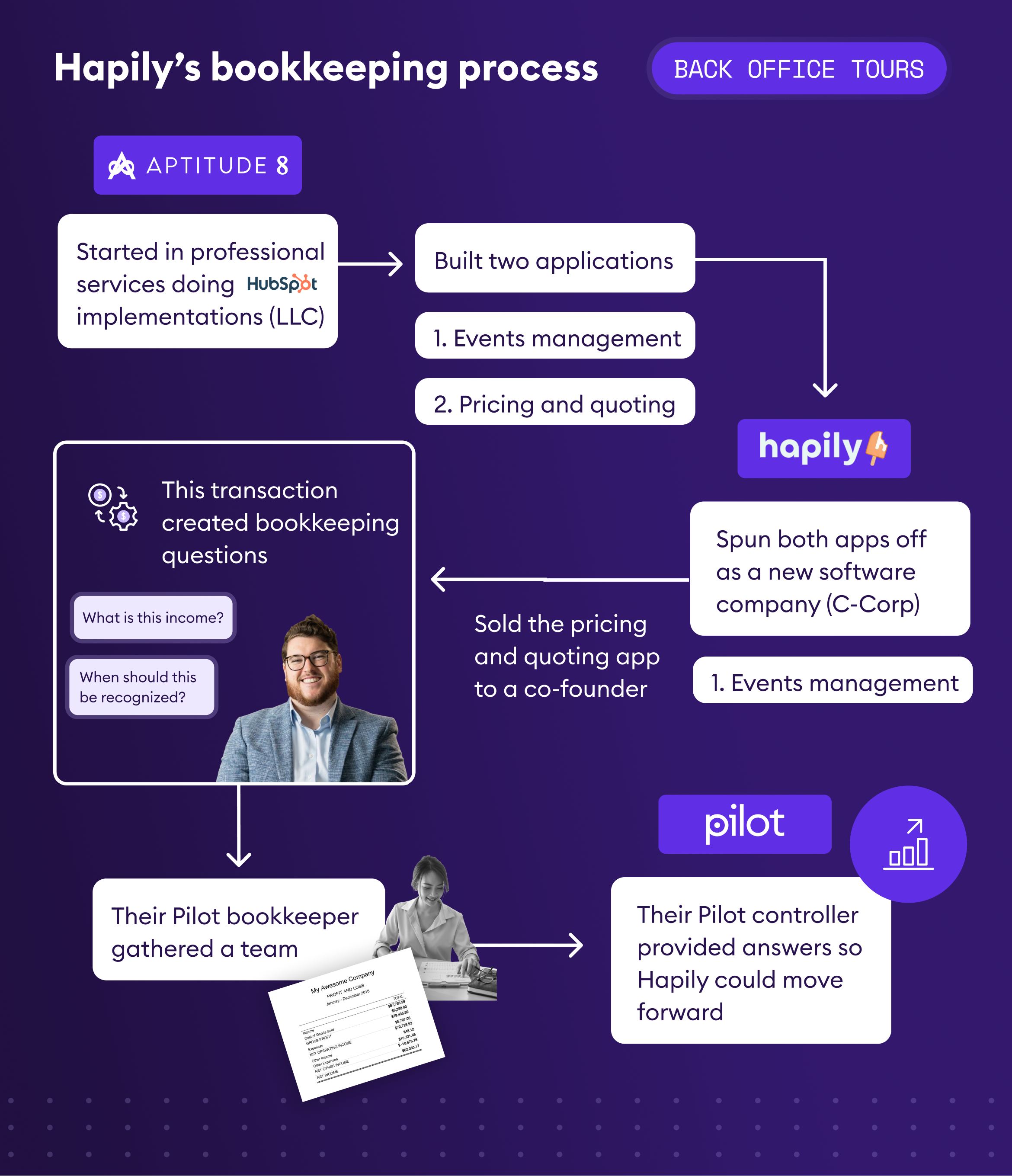
Connor had done some mergers and acquisitions while running the agency, and assumed it would be easy enough to structure this sale as an asset sale.
“We figured, we’re really simple. We have Stripe subscription revenue, we have employees, and we lose money. There’s not a lot to handle, so we looked for a bookkeeping and tax partner and found Pilot,” says Connor. They chose Pilot because the software was much better than QuickBooks, the cost was reasonable, and they’d get a human bookkeeper. But that Pilot bookkeeper kept asking questions.
“Pilot saw the transaction from the sale and asked, ‘What is this and where does it go?’” says Connor. “We said, ‘Oh yeah, this is the first payment. We sold this asset, just log it as revenue. It's fine. Our losses will exceed this so it kind of shouldn't matter. And Pilot replied, ‘Well, it doesn't work that way because it's an asset and you're a C-corp and this is actually messier.’ Originally, our hearts sank, but everyone was friends in that sale and we could fix the transaction. But that experience with Pilot was really amazing.”
Pilot replied, ‘Well, it doesn't work that way because it's an asset and you're a C-corp and this is actually messier.’
A Pilot controller joined the next call, having reviewed Hapily’s full year of financials and the 15-page purchase agreement. They offered exact advice on how to reduce the purchase price based on a reasonably assumed inability to collect some of the revenue. Hapily should put that under net income, and recognize the rest now so they wouldn’t have to do so in future years.
“They solved something that probably would've been a big, expensive, complicated problem for us down the road,” says Connor. “ Having done a couple of businesses and worked with a lot of different bookkeeping providers, that's the first time I've had an experience that I was like, ‘Wow, this actually far exceeded my expectations. It would have been entirely reasonable for Pilot to say, ‘You need to go get outside advice because that’s beyond the scope,’ but they didn’t, and that surprise and delight is just amazing.”
It would have been entirely reasonable for Pilot to say, ‘You need to go get outside advice because that’s beyond the scope,’ but they didn’t, and that surprise and delight is just amazing.
Now Hapily is growing and feels the Pilot bookkeeping and tax solutions are set to scale. Connor and team have access to their books and all their financials through the Pilot portal, where they can click to drill down into any number. “I am not an accountant and QuickBooks is not a delightful experience for me,” laughs Connor. “So the Pilot application layer makes it really easy to get to the information I care about, as opposed to taking screenshots of QuickBooks and then emailing people back and forth. Being able to have all that context is really powerful.”
And of course, their human bookkeeper and tax preparer are there with questions, working as a team, ensuring they’re making the most of their runway.
“ The team is very knowledgeable, very responsive, and just feels very on top of it,” says Connor. “As opposed to others, where it feels like people are behind a ticketing system. With Pilot, we get this personalized experience.”
.svg)

.svg)
.svg)
Hapily is a software studio building applications to help customers do more with HubSpot.
Connor Jeffers and his co-founders built a professional services firm, Aptitude 8, around helping companies implement the marketing software HubSpot. The business succeeded so quickly, the founders thought, why not try another revenue stream? When HubSpot launched an app store, Connor and team built a few apps. Those took off.
Soon they were confronted with their own success, had to prioritize, and decided to split the businesses—one services, one software. Their existing accounting firm wanted $20,000 to do the the books for Hapily, the new business, even though it was venture-funded and the initial work was minimal. Connor and team had heard about Pilot on the Acquired podcast and gave it a try.
Their Pilot bookkeeper surprised them by not doing as asked, and instead brought in help to advise on how to best structure the sale. This ended up saving Hapily a lot of money.
“It’s so easy to do what the client says, but we were wrong,” says Connor. “Pilot didn’t just say ‘Yes.’ They intervened and, at no extra cost to us, involved someone to get us sorted out. I’ve been doing this a long time and I have not had many experiences this positive.”
Agencies have lots of advantages. They’re easy to start and tend to be profitable from day one. But they don’t scale the same way a software does, with low or zero marginal costs. Connor and team grew their agency to 75 people and eight figures in revenue and decided it was time to experiment with other models.
Around this time, HubSpot launched an app store and Connor and team built a few apps, one for events management, one for pricing and quoting. The idea was to diversify their revenue. They’d create one app that was free, to attract attention, and another that was to make money. This worked remarkably well. So well that they made the decision to spin out the software business on its own, which became Hapily. During that transition, one of the co-founders raised money and offered to buy the price-quoting part of the business—which sounded great.
Connor had done some mergers and acquisitions while running the agency, and assumed it would be easy enough to structure this sale as an asset sale.
“We figured, we’re really simple. We have Stripe subscription revenue, we have employees, and we lose money. There’s not a lot to handle, so we looked for a bookkeeping and tax partner and found Pilot,” says Connor. They chose Pilot because the software was much better than QuickBooks, the cost was reasonable, and they’d get a human bookkeeper. But that Pilot bookkeeper kept asking questions.
“Pilot saw the transaction from the sale and asked, ‘What is this and where does it go?’” says Connor. “We said, ‘Oh yeah, this is the first payment. We sold this asset, just log it as revenue. It's fine. Our losses will exceed this so it kind of shouldn't matter. And Pilot replied, ‘Well, it doesn't work that way because it's an asset and you're a C-corp and this is actually messier.’ Originally, our hearts sank, but everyone was friends in that sale and we could fix the transaction. But that experience with Pilot was really amazing.”
Pilot replied, ‘Well, it doesn't work that way because it's an asset and you're a C-corp and this is actually messier.’
A Pilot controller joined the next call, having reviewed Hapily’s full year of financials and the 15-page purchase agreement. They offered exact advice on how to reduce the purchase price based on a reasonably assumed inability to collect some of the revenue. Hapily should put that under net income, and recognize the rest now so they wouldn’t have to do so in future years.
“They solved something that probably would've been a big, expensive, complicated problem for us down the road,” says Connor. “ Having done a couple of businesses and worked with a lot of different bookkeeping providers, that's the first time I've had an experience that I was like, ‘Wow, this actually far exceeded my expectations. It would have been entirely reasonable for Pilot to say, ‘You need to go get outside advice because that’s beyond the scope,’ but they didn’t, and that surprise and delight is just amazing.”
It would have been entirely reasonable for Pilot to say, ‘You need to go get outside advice because that’s beyond the scope,’ but they didn’t, and that surprise and delight is just amazing.
Now Hapily is growing and feels the Pilot bookkeeping and tax solutions are set to scale. Connor and team have access to their books and all their financials through the Pilot portal, where they can click to drill down into any number. “I am not an accountant and QuickBooks is not a delightful experience for me,” laughs Connor. “So the Pilot application layer makes it really easy to get to the information I care about, as opposed to taking screenshots of QuickBooks and then emailing people back and forth. Being able to have all that context is really powerful.”
And of course, their human bookkeeper and tax preparer are there with questions, working as a team, ensuring they’re making the most of their runway.
“ The team is very knowledgeable, very responsive, and just feels very on top of it,” says Connor. “As opposed to others, where it feels like people are behind a ticketing system. With Pilot, we get this personalized experience.”
.svg)